

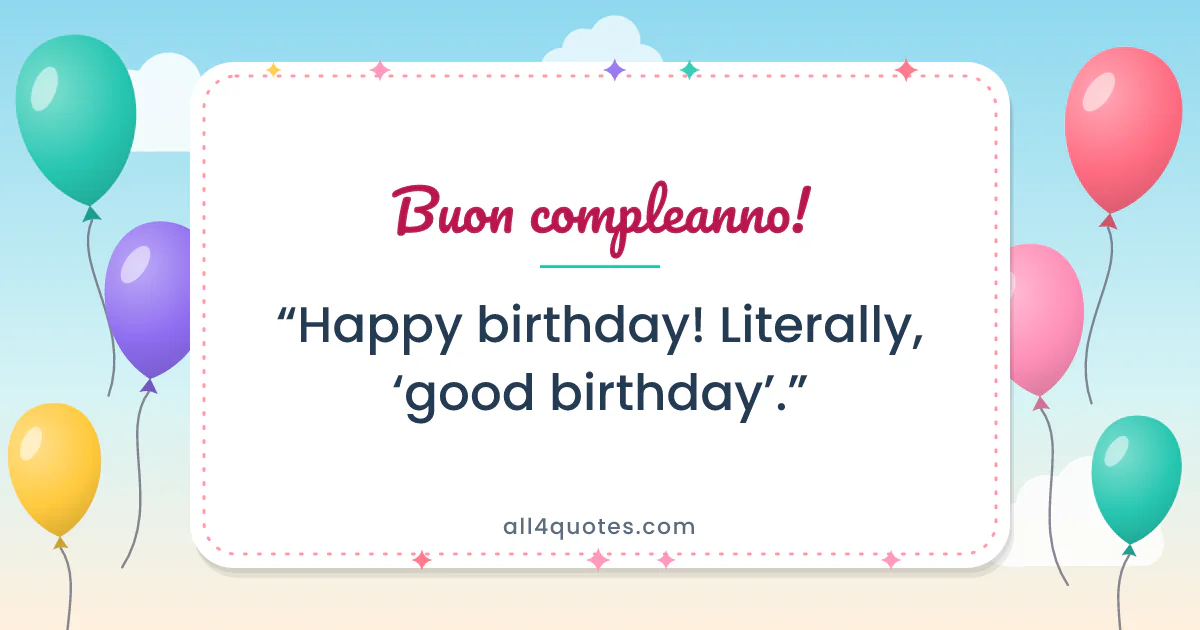
The most common way to say happy birthday in Italian is Buon compleanno! (bwohn kom-pleh-AHN-noh). For something warmer or more flexible, Italians also say Tanti auguri! (“many good wishes”) or simply Auguri! This guide explains what each phrase means, how to pronounce it, when to use it with friends, family or colleagues, and the mistakes learners make most often.
The short answer: Italian birthday phrases at a glance
| Italian | How to say it | Literal meaning | When to use it |
|---|---|---|---|
| Buon compleanno! | bwohn kom-pleh-AHN-noh | “good birthday” | The standard phrase, for anyone at any age. Used for birthdays only. |
| Tanti auguri! | TAHN-tee ow-GOO-ree | “many wishes” | Warm and friendly. Also used for Christmas, weddings, a new job and other occasions. |
| Auguri! | ow-GOO-ree | “wishes” | The short version. Casual, and works on a birthday or any other celebration. |
| Tanti auguri di buon compleanno! | TAHN-tee ow-GOO-ree dee bwohn kom-pleh-AHN-noh | “many wishes of a good birthday” | The fuller version, good for cards and for colleagues. |
| Auguroni! | ow-goo-ROH-nee | “big wishes” | Informal and playful, for friends and family. |
| Felice compleanno! | feh-LEE-cheh kom-pleh-AHN-noh | “happy birthday” | Correct, but less common in everyday speech than buon compleanno. |
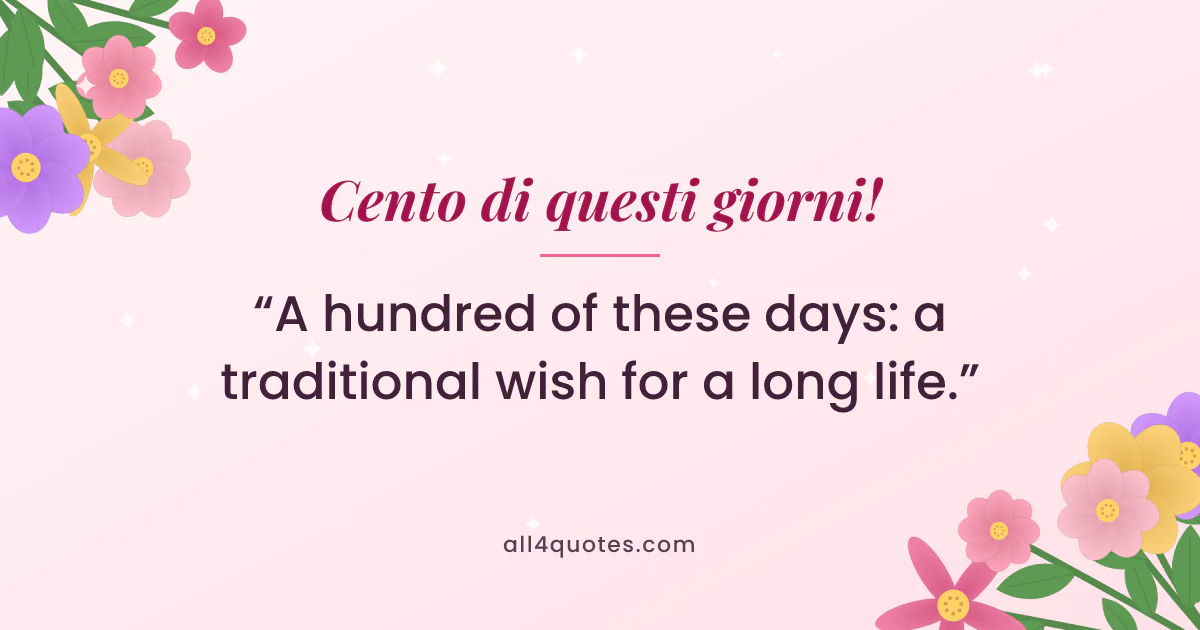
| Cento di questi giorni! | CHEN-toh dee KWEH-stee JOR-nee | “a hundred of these days” | A traditional, slightly old-fashioned wish for a long life, often said to older people. |
| Auguri in ritardo! | ow-GOO-ree een ree-TAR-doh | “belated wishes” | When your wishes arrive after the day. |
If you only learn one phrase, learn Buon compleanno! If you want one phrase that works almost everywhere, Auguri! or Tanti auguri! is a safe choice. The Italian dictionary Treccani gives auguri di buon compleanno as an example under augurio and lists tanti auguri among its set phrases (see Treccani: augurio).
How to pronounce the phrases
How to read the respellings: capital letters mark the stressed syllable; ah as in “father”, eh as in “bed”, ee as in “see”, oh as in “go” (short and pure, without the English glide), oo as in “moon”, ow as in “cow”, ch as in “chair”, ny as in “canyon”, ly as in “million”. Italian vowels are always pronounced, even at the end of a word, and doubled consonants (nn, mm, tt) are held a little longer. These respellings are simplified approximations for English speakers, not a phonetic transcription.
Two things help most. First, the stress in compleanno falls on the “an” (kom-pleh-AHN-noh), not on the first syllable. Second, auguri starts with the sound “ow” and the stress is on “goo” (ow-GOO-ree). Listening to a native speaker once or twice will fix the details that no respelling can show.

What “buon compleanno” means, word by word
Buon is the short form of buono (“good”). It is buon and not buona because compleanno is a masculine noun. Treccani records compleanno as a word Italian borrowed from Spanish cumpleaños, itself built from cumplir (“to complete”) and año (“year”) (Treccani: compleanno).
Auguri is the plural of augurio, a wish for something good to happen. In this sense it is always plural, which is why the phrase is tanti auguri (“many wishes”). Because auguri simply means good wishes, it also works for holidays and other occasions.
Formal or informal?
The short phrases above are neutral: you can say Buon compleanno! or Tanti auguri! to a friend, a grandparent or a boss. The difference appears when you add a full sentence. Italian uses tu with friends and family and the polite Lei with people you do not know well, older people or people in authority.
Ti auguro un felice compleanno!
Translation: I wish you a happy birthday! (informal, tu)
Le auguro un felice compleanno.
Translation: I wish you a happy birthday. (formal, Lei)
To add a name, put a comma before it: Buon compleanno, Marco! On a card, start with Caro Marco (to a man) or Cara Giulia (to a woman). Carissimo and carissima are warmer.
How to reply when someone wishes you happy birthday
- Grazie! (GRAH-tsyeh): thank you.
- Grazie mille! (GRAH-tsyeh MEEL-leh): thank you very much.
- Grazie di cuore! (GRAH-tsyeh dee KWOH-reh): heartfelt thanks.
Do not answer with Auguri anche a te! on your own birthday. That reply belongs to occasions everyone shares, such as Christmas or New Year, when both people exchange wishes.
Late wishes, and early ones
If you forgot, say Auguri in ritardo! or, more personally, Scusa il ritardo, tanti auguri! (“sorry I’m late, many wishes”). With someone you address as Lei, use Scusi il ritardo. Wishing early is a different matter: many Italians say it brings bad luck to wish someone a happy birthday before the day itself. It is a popular belief rather than a rule, and not everyone follows it. See Italian birthday traditions for more on this and other customs.
Common mistakes to avoid
- “Buona compleanno”. Compleanno is masculine, so the correct form is buon compleanno.
- Capital letters. Italian does not capitalise buon compleanno the way English capitalises “Happy Birthday” in a title. Use a capital letter only at the start of a sentence.
- Using “felicitazioni” on a birthday. Felicitazioni and congratulazioni mean “congratulations”: you congratulate someone on something they have done or experienced. For a birthday, Italians say auguri.
- “Feliz cumpleaños”. That is Spanish. The Italian is buon compleanno.
- Spelling. Compleanno has a double n, and auguri has a u after the g: it is pronounced ow-GOO-ree.
Keep learning
- Italian birthday wishes and messages, with translations: ready-to-use messages for friends, family, partners and colleagues.
- Italian birthday traditions, name days and the birthday song: what Italians do on the day, and what Tanti auguri a te is.
- Talking about birthdays in Italian: how to ask when someone’s birthday is, how old they are turning, and how to answer.
Already reading Italian? These pages on this site are written in Italian: Come fare gli auguri di buon compleanno and 40 frasi semplici di auguri di buon compleanno.
Frequently asked questions
How do you say happy birthday in Italian?
Say Buon compleanno! (bwohn kom-pleh-AHN-noh). Tanti auguri! and Auguri! are also very common.
Is it “buon compleanno” or “tanti auguri”?
Both are natural. Buon compleanno names the occasion (a birthday). Tanti auguri means “many good wishes” and fits many occasions, so on a birthday people often combine them: Tanti auguri di buon compleanno!
How do you say “happy birthday to you” in Italian?
The birthday song is Tanti auguri a te, sung to the “Happy Birthday to You” tune. As a plain wish, you can say Buon compleanno a te! More on the song on the traditions page.
Is it the same for a man and a woman?
Yes. Buon compleanno does not change. Only the words around it do, for example caro / cara (dear), amico / amica (friend) and fratello / sorella (brother / sister).
Is “felice compleanno” wrong?
No, it is correct Italian and means “happy birthday”. It is simply less common in everyday speech than buon compleanno.
Sources
Treccani, Vocabolario: compleanno, augurio. Usage notes on birthday phrases, replies and timing were cross-checked against the language guide Think in Italian: how to say happy birthday in Italian.